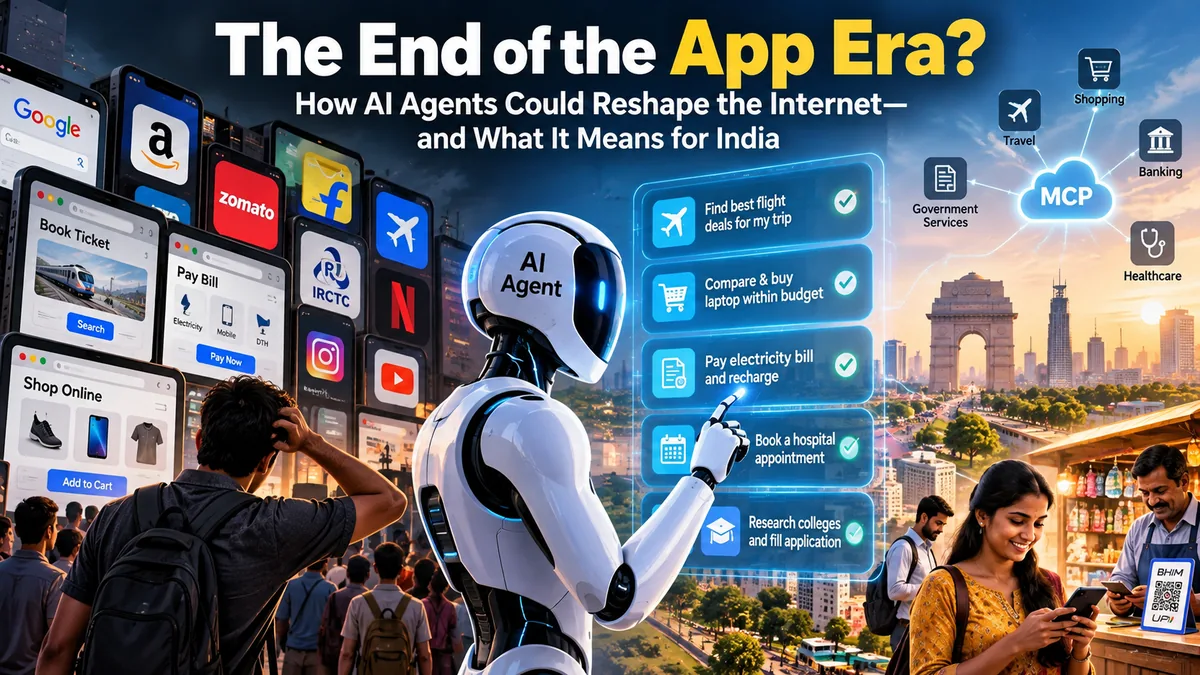
The End of the App Era? How AI Agents Could Reshape the Internet—and What It Means for India
The next major shift in how people use the internet may not be a new social network, marketplace or mobile app. It may be a change in who operates the interface.
Instead of opening a shopping app, checking three delivery services, comparing prices, filling out forms and tracking an order, a person could tell an AI agent what they want and let it coordinate the steps. Instead of navigating several business dashboards, a small business owner could ask an agent to reconcile invoices, draft replies, check stock and prepare a payment for approval.
The underlying services would still exist. Websites, APIs, payment networks, inventory systems and business databases would continue doing the work. But the customer might no longer interact with each service directly.
This is the possibility behind the phrase “the end of the app era.” It does not mean apps will disappear overnight. It means apps may increasingly become infrastructure that other software operates on behalf of people.
For India, the outcome matters beyond technology. It could lower the cost of using digital services for consumers and small businesses, create new opportunities for Indian software firms, and make digital commerce more accessible. It could also move power from today’s platforms to a smaller set of AI intermediaries.
From apps to agents: what is actually changing?
Traditional software is organised around interfaces and workflows designed by each company. A user learns how a service works, opens its app or website, navigates menus and performs a sequence of actions.
An AI agent changes the starting point. A user describes an outcome—“find a reliable courier under ₹150 and prepare the booking,” for example—and the agent can plan steps, call tools, inspect results and return with a proposed action. Depending on its permissions and reliability, it may complete some steps itself and ask the user to approve others.
Three layers make this possible:
- The model interprets the request, reasons about the next step and decides which tools may help.
- The tools and integrations expose current information and actions such as searching products, reading a calendar, updating a customer record or creating a booking.
- The underlying service still holds the authoritative data and performs the actual operation.
The distinction is important. A language model alone cannot reliably know live stock, a bank balance or an order status. It needs a data source or tool. Nor does calling a tool guarantee that the result is correct or that an action is authorised.
Why MCP has become part of the conversation
The Model Context Protocol (MCP) is an open standard introduced by Anthropic in November 2024 to make it easier for AI applications to connect with external systems. It standardises how compatible clients and servers exchange context and expose tools, reducing the need to build a bespoke integration for every combination of AI application and service.
Think of it as a common connector—not an AI agent in itself. MCP does not provide the model, business logic, payment authorisation or trustworthiness of a service. It makes a defined set of capabilities available through a standard interface.
The ecosystem has grown quickly. In December 2025, Anthropic said the protocol had more than 10,000 active public MCP servers and had been adopted by products including ChatGPT, Cursor, Gemini, Microsoft Copilot and Visual Studio Code. These are ecosystem indicators reported by a protocol contributor, not independently audited measures of production transactions or paying customers. The protocol’s July 2026 specification release further emphasised stateless operation, more scalable HTTP deployments and stronger authorisation patterns.
This matters economically because integrations have always been expensive. Each software company has had to decide which external systems to connect, maintain and support. Common protocols can lower part of that cost. If agents can discover and use many services through interoperable tools, developers may spend less time building one-off connectors and more time improving the service itself.
But a standard connector does not solve every interoperability problem. Different services can describe similar concepts differently, return incomplete data, charge different fees, impose different rules or permit different actions. A common protocol can make systems reachable without making them equivalent.
The real question: who owns the interface?
When a person searches directly on a marketplace or opens a business’s website, the business may gain a customer relationship: the visit, brand exposure, recommendations, account registration and sometimes repeat purchase.
When an AI agent does the discovery, the user may see only a short list of recommendations—or one final result. The agent may become the place where preferences are stored, comparisons occur and decisions are made.
That creates a possible shift in bargaining power.
| Today’s app-centred model | Possible agent-centred model |
|---|---|
| User searches and navigates each service | User states an outcome once |
| Platforms compete for screen time | Services compete to be selected by agents |
| Businesses optimise app experience and search ranking | Businesses also need accurate, machine-readable capabilities |
| Customers build habits inside individual apps | Agents may retain preferences across services |
| Each integration can require custom work | Shared protocols may lower integration costs |
This is a scenario, not a settled forecast. Consumers may continue opening apps for trust, entertainment, visual discovery, loyalty benefits or complex decisions. Businesses may also restrict automation, charge for access or create agent-specific experiences. The likely future is a mix: some tasks move to agents, while others remain in conventional interfaces.
The more consequential change may be less about the disappearance of apps than about who controls discovery, customer data, transaction routing and the default recommendation.
Why India’s digital foundations make this especially interesting
India has already built experience with digital public infrastructure: shared rails that enable many organisations to provide services without every participant having to recreate the same basic network.
The National Payments Corporation of India’s UPI system is a familiar example in payments. The Open Network for Digital Commerce (ONDC) is an effort to make digital commerce interoperable across buyer and seller applications. Their designs and outcomes differ, but both demonstrate a policy interest in networks where participation is not meant to depend entirely on one closed consumer app.
The potential connection to AI agents is straightforward: agents need reliable ways to discover services, access information and request actions. Open, well-governed rails could give agents a wider field of services to work with—if they provide usable machine interfaces, permission controls and clear transaction rules.
India’s digital reach is a meaningful foundation, though not proof that agents will be adopted universally. The Ministry of Statistics and Programme Implementation’s Comprehensive Modular Survey: Telecom, conducted in January–March 2025, estimated that 85.5% of Indian households had at least one smartphone and 86.3% had internet access within the household premises. Those figures describe household access, not reliable connectivity at every moment, digital literacy, device ownership by every household member or the ability to use complex AI tools.
That gap matters. An agent could help a person who finds a complicated website difficult to navigate, especially when it can communicate in a familiar language and explain each step. But it could also exclude people who lack suitable devices, affordable access, language support or confidence in automated decisions.
The opportunity for India’s small businesses
India’s micro, small and medium enterprises (MSMEs) are a major part of the economy, but many operate with thin margins and limited time for software administration. They may rely on a mix of messaging apps, spreadsheets, accounting packages, marketplace dashboards, phone calls and manual records.
A capable agent connected to approved business tools could help with repetitive coordination:
- A neighbourhood retailer could check inventory, prepare reorder suggestions and draft supplier messages.
- A small manufacturer could turn purchase orders into structured records, flag missing details and prepare dispatch updates.
- A travel operator could compare availability, assemble an itinerary and draft a quotation.
- A local service provider could classify enquiries, schedule appointments and follow up on unpaid invoices.
These examples describe plausible workflows, not measured evidence that agents currently deliver a particular productivity gain in these settings. Actual value would depend on data quality, integration cost, language support, reliability and the cost of errors.
The World Economic Forum and Boston Consulting Group’s 2025 AI Playbook for India’s MSMEs identifies resource constraints, scalability challenges and barriers to adoption as important issues for small businesses. The report estimates substantial potential economic value from AI, but potential value should not be confused with gains already realised. An agent may simplify the interface while leaving the hard work—cleaning inventory records, digitising invoices, configuring permissions and changing staff workflows—untouched.
For the smallest businesses, the winning product may not be a sophisticated autonomous assistant with dozens of integrations. It may be a narrow, affordable tool that reliably performs one job in the language and workflow the business already uses.
Could agents make websites less important but APIs more valuable?
Possibly. A website is primarily designed for people to read and interact with. An API exposes structured data or actions to software. MCP provides a standard way for compatible AI clients to discover and invoke tools offered by a server.
An agent-facing service still needs useful capabilities. A product catalogue should expose accurate prices and availability; a booking service should return clear terms and confirmation status; an accounting tool should distinguish reading a record from changing or deleting it. If the data behind a service is unreliable, exposing it to an agent will not make it reliable.
This suggests a practical strategy for Indian developers and software companies: make business functions accessible through stable, documented and permissioned interfaces, while retaining a usable conventional website. Do not assume that implementing MCP alone will bring users or revenue. Businesses still need distribution, trust, pricing, support, security and a reason for customers to choose their service.
There could also be a new market for small, specialised integrations. A developer who understands a local business process—regional logistics, tax workflows, wholesale ordering or vernacular customer support—could build a useful tool without having to build an entire general-purpose platform. Whether such businesses can earn sustainable revenue will depend on discovery, customer acquisition, maintenance and the economics of AI usage.
The uncomfortable side: new gatekeepers, not no gatekeepers
If agents become the primary route to services, businesses may trade dependence on app stores and marketplaces for dependence on agent providers. A service might be technically open to every agent and still receive little traffic if one dominant assistant controls most user decisions.
This raises several risks:
1. Discovery could become less transparent. A user may not know why an agent selected one seller, product or service over another. Ranking criteria, paid placement, affiliate commissions and commercial relationships can influence recommendations unless they are disclosed and controlled.
2. Small businesses could face a new optimisation burden. Instead of paying to appear in search results or marketplaces, they may need to make themselves discoverable to multiple agent ecosystems, comply with different policies or pay for preferred visibility.
3. Interoperability may exist on paper but not in practice. A protocol can be open while a dominant service controls user identity, permissions, transaction history and the agent interface. Technical openness does not automatically create a competitive market.
4. Automation can amplify mistakes. A wrong interpretation is inconvenient when an agent drafts text; it is more serious when it sends a payment, cancels a booking, places an order or changes a customer record.
For these reasons, an “agent-ready internet” should be assessed not only by how many tools connect, but also by whether users can switch agents, businesses can reach customers on fair terms, and transactions remain auditable.
Security and liability become economic questions
Agents may be exposed to malicious instructions hidden in webpages, documents, emails or tool responses. A connection can be legitimate while the content it returns is untrusted. Research into MCP security has documented risks involving tool descriptions, poisoned outputs and unauthorised actions. The practical lesson is that a standard protocol is not a security guarantee.
Safe implementations need least-privilege permissions, clear confirmation for consequential actions, strong credential handling, logs, revocation, rate limits and isolation between data sources. A tool that only reads public product information should not receive permission to initiate payments. Access tokens should be scoped to the intended service, not passed around indiscriminately.
For commerce in India, the consequences also extend to refunds, consumer grievances, fraud, data protection and responsibility when an agent acts incorrectly. The government’s India AI Governance Guidelines, released in November 2025, frame responsible AI adoption around principles that include accountability and harm prevention. The precise legal obligations depend on the service and activity; the guidelines should not be treated as a substitute for applicable law or sector-specific rules.
Trust cannot be delegated entirely to a model. Users need to know what an agent is authorised to do, what it actually did, and how to undo or challenge an action.
The economic distribution question: who captures the productivity gain?
Suppose an agent saves a shop owner two hours each week. That time could become more customer service, more orders, lower operating costs, shorter working hours or simply a transfer of administrative work from a person to software. The outcome depends on the business and the market; time saved is not automatically revenue earned.
The same distinction applies at national scale. If agents reduce the cost of software use, Indian firms may become more productive. But part of the value may flow to model providers, cloud infrastructure, payment services or agent platforms through usage charges and commissions. Businesses may retain the gains only when competition, switching options and pricing discipline give them bargaining power.
India has a strategic choice between being mainly a user of imported agent platforms and building valuable layers around them: local-language interfaces, sector-specific tools, reliable data services, secure infrastructure, and open commerce and public-service integrations. These options are not mutually exclusive. An Indian firm can use global models while still owning domain expertise, customer relationships and software products.
The IndiaAI Mission, approved with an outlay of ₹10,371.92 crore in 2024, is intended to expand domestic AI capabilities and access to compute, among other goals. That is relevant infrastructure policy, but an allocation is not the same as a realised commercial outcome. The broader challenge is translating compute and model access into tools that solve real problems at a price Indian users can sustain.
What should Indian businesses do now?
Most businesses do not need to rebuild everything around agents today. They can take a staged approach.
- Clean up the underlying information. Keep prices, inventory, customer records, terms and service status accurate. Automating bad data makes errors faster.
- Expose a few useful, safe functions. Start with read-only search, status checks or draft preparation. Add transactional actions only after testing and access controls are mature.
- Keep humans in control of costly or irreversible decisions. Require explicit approval for payments, cancellations, sensitive data sharing and material changes.
- Measure outcomes, not demonstrations. Track completion rate, time saved, correction rate, support burden, cost per successful task and user satisfaction.
- Avoid dependence on a single agent. Where feasible, use documented interfaces and portable data so a business can reach multiple clients and retain a direct relationship with customers.
- Design for Indian conditions. Test regional-language input, mixed-language conversations, poor connectivity, low-cost devices and clear explanations of fees and consent.
These recommendations are deliberately incremental. A working agent needs more than a striking demo: it needs predictable performance, a support path when something goes wrong and unit economics that justify continued use.
What would prove that the app era is actually ending?
The strongest evidence would not be the number of MCP servers, social-media demonstrations or announcements from technology companies. Those show activity in the ecosystem, not the share of economic activity handled by agents.
A more useful scorecard would track:
- The share of online tasks completed end-to-end through agents rather than merely assisted by them.
- The cost and failure rate of agent-mediated transactions compared with conventional interfaces.
- Adoption by small businesses outside major technology hubs.
- The share of transactions routed through open networks versus closed platforms.
- Whether users can switch agents without losing their records, preferences or access to services.
- How much of the productivity gain is retained by customers and small businesses rather than paid out as platform fees.
India should also track distribution: gains among urban and rural users, English and non-English speakers, large firms and micro-enterprises. Average adoption could hide a widening gap between businesses with clean digital systems and those still relying on paper, voice calls and informal records.
The likely future: apps become infrastructure, agents become the interface
The most plausible near-term outcome is not a web without apps. It is a layered internet in which conventional apps remain useful, but increasingly expose capabilities that agents can call. Users may delegate routine coordination while returning to traditional interfaces for trust-sensitive, visual or complex decisions.
MCP is one piece of that transition: a common way for AI systems to connect to tools. It is neither the whole agent stack nor proof that autonomous transactions will dominate. Protocols can reduce integration friction, but they cannot by themselves solve security, market power, data quality or consumer protection.
For India, the opportunity is bigger than building another assistant. It is to ensure that an agent-mediated internet remains open enough for a small seller in a tier-2 city, a specialised Indian software company and a large enterprise to participate on reasonable terms. Digital public infrastructure offers a useful precedent: shared rails can broaden access when governance, participation and accountability are designed well.
The decisive question is therefore not whether AI agents will replace apps. It is whether agents will make the internet easier for ordinary people and small businesses to use—or simply put a new gatekeeper between them and the services they depend on.
Sources and further reading
- Anthropic. Introducing the Model Context Protocol. 25 November 2024. Original announcement explaining MCP’s purpose and architecture.
- Anthropic. Donating MCP to the Agentic AI Foundation. 9 December 2025. Reports ecosystem adoption figures and governance transition.
- Model Context Protocol. The 2026-07-28 Specification. 28 July 2026. Specification changes, including stateless operation and authorisation hardening.
- Ministry of Statistics and Programme Implementation. Comprehensive Modular Survey: Telecom, 2025. Survey conducted January–March 2025; household and individual technology access estimates.
- World Economic Forum and Boston Consulting Group. Transforming Small Businesses: An AI Playbook for India’s MSMEs. 17 October 2025. MSME adoption barriers and potential AI use cases.
- Government of India, Press Information Bureau. Cabinet approves the IndiaAI Mission. 7 March 2024. Mission scope and approved outlay.
- ONDC. About ONDC. Overview of open-network design and intended role in digital commerce.
- Government of India, Press Information Bureau. India AI Governance Guidelines. 5 November 2025. National AI governance framework.
- Hou X, Zhao Y, Wang S, et al. Model Context Protocol (MCP): Landscape, Security Threats, and Future Research Directions. ACM Transactions on Software Engineering and Methodology. Published online 16 September 2026. Review of MCP architecture, threat scenarios and mitigation needs.
Scope and limitations: This is a research-based analysis and scenario assessment, not a forecast supported by a quantitative economic model. Published adoption figures come from the cited organisations and may use different definitions or sampling methods. The economic effects of agent-mediated browsing and transactions in India are still uncertain; the article distinguishes existing infrastructure and published findings from plausible future outcomes.