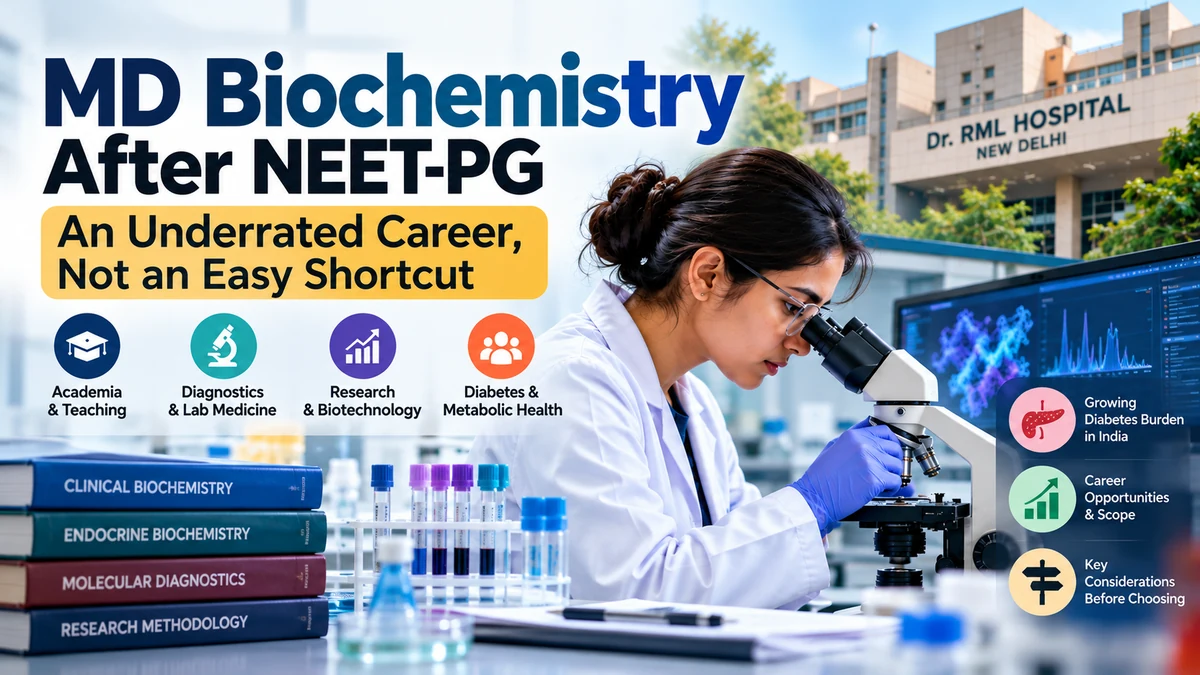
MD Biochemistry After NEET-PG: An Underrated Career, Not an Easy Shortcut
MD Biochemistry is often reduced to one outcome: teaching undergraduate students. That misses real opportunities in clinical laboratories, diagnostics, biomedical research and the pharmaceutical or biotechnology industry. But the opposite claim—that it guarantees an easy, high-income alternative to clinical medicine—is just as misleading.
For a candidate who genuinely enjoys metabolism, laboratory science and research, it deserves a closer look.
What do the RML Hospital cutoffs show?
A query of the Desire counselling database for ABVIMS–Dr. Ram Manohar Lohia Hospital, New Delhi; AIQ; All India quota; Open category; MD Biochemistry returned these closing-rank records:
| Year | Round 1 closing rank | Round 3 closing rank |
|---|---|---|
| 2023 | 41,706 | 59,854 |
| 2024 | 40,142 | 60,874 |
| 2025 | 27,956 | 58,763 |
| 2026 | 35,840 | Not compared here |
The closing rank is the highest AIR recorded in the queried allotments for that year and round. Round 1’s closing rank was 41,706 in 2023, 40,142 in 2024, 27,956 in 2025 and 35,840 in 2026. In Round 3, the closing rank was 59,854 in 2023, 60,874 in 2024 and 58,763 in 2025.
This makes the branch look attainable compared with highly competitive clinical specialties. But treat these as database-recorded allotments, not a prediction of future cutoffs. The 2025 Round 1 query returned only one Open-category rank record, so that year’s result especially should not be mistaken for a complete distribution. Cutoffs vary with seat availability, choices, eligibility and counselling rules.
More than teaching—but choose a direction
Potential pathways include:
- Medical college faculty: the most established route, with progression depending on applicable eligibility rules, vacancies, experience and research.
- Clinical biochemistry and diagnostics: laboratory quality systems, method validation, specialised assays, automation, accreditation and laboratory leadership.
- Research: metabolism, diabetes, biomarkers, molecular diagnostics, proteomics and translational science. Competitive research careers may require additional methods training, publications, a PhD or postdoctoral work.
- Diagnostics, biotech and pharma: assay development, technical scientific roles, quality systems and research and development. Suitable MD-level vacancies are not guaranteed, and some roles prefer specialised or industry experience.
The department matters. A well-equipped institute with active research, strong supervision and hands-on laboratory training can offer opportunities that a department focused mostly on routine teaching may not.
The diabetes connection: promising, but not a shortcut
India’s ICMR–INDIAB study estimated 101 million people with diabetes and 136 million with prediabetes. It also reported 11.4% weighted diabetes prevalence and 15.3% prediabetes prevalence, with the epidemic still increasing in many states. These estimates come from the national study published in The Lancet Diabetes & Endocrinology in 2023; they are not live 2026 counts. (Study and findings)
That burden creates a continuing need for diabetes care and metabolic research. Biochemistry provides a strong scientific foundation for understanding glucose and lipid metabolism, insulin resistance, biomarkers and complications.
There is an important distinction, however: some diabetology fellowships accept MBBS graduates, but eligibility varies by programme. MD Biochemistry does not automatically make a graduate an endocrinologist or guarantee a clinical diabetology position. A doctor interested in patient-facing diabetes care must check programme eligibility, clinical supervision, credential recognition and the applicable scope of practice.
Could an interested doctor build an affordable diabetes-focused practice, perhaps in an underserved area? In principle, access, continuity, good communication and appropriate fees can help. In practice, building a patient base is difficult. Patients and referrers may prefer physicians with conventional clinical postgraduate training, and complex cases require appropriate referral. Lower fees alone do not guarantee demand or sustainable income.
The financial case at a premier institute
The stipend can materially change the decision. ABVIMS–RML’s published 2025–26 stipend declaration lists monthly MD/MS resident payments of ₹1,52,970 in year one, ₹1,57,170 in year two and ₹1,61,580 in year three. Check the institute’s official stipend declaration for the relevant year and confirm current payment details before counselling decisions.
That is a substantial residency income alongside training at a prominent central teaching hospital. RML may be a compelling option for someone who values its academic environment and facilities, but “unmatched in all of India” would be an unsupported absolute claim. Compare actual resident experience, laboratory access, faculty mentorship and graduate outcomes rather than relying on reputation alone.
The realistic verdict
MD Biochemistry is not a dead end, but its strongest established routes are academia, diagnostics and research. Metabolic science is a meaningful area of growth; a clinical diabetology career is a separate possibility that requires careful credential and training checks, not an automatic outcome of the MD.
Consider it if you are curious about the science, willing to build a specific skill set and comfortable with a career that may be less conventionally clinical. Do not choose it solely because the rank is achievable, the stipend is attractive or you hope to practise as a diabetologist later.
Cutoff methodology: Desire’s Neon PostgreSQL public.candidates records, filtered to AIQ, the stated year and round, All India quota, Open category, Biochemistry and ABVIMS–Dr. RML Hospital, New Delhi. Only the closing rank (maximum AIR in the returned records) is shown for each year-round combination. The 2025 Round 1 query returned one matching rank record; database records may not capture every allotment if source data or institute naming differs. Stipend figures are from the institute’s published 2025–26 declaration; prevalence figures are from the cited ICMR–INDIAB study.